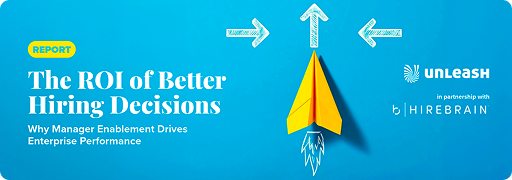





New research from UNLEASH, produced in partnership with HireBrain, confirms just how significant of a problem role clarity problem has become for organizations heading into 2026. The findings show that as AI accelerates and business strategy evolves faster than ever, hiring teams continue to operate without the foundational clarity needed to make consistently strong decisions.
In short, the data validates what TA leaders have felt intuitively for years:
hiring breaks down when teams are unclear on what success in the role actually looks like.
As we head into 2026, that lack of clarity is no longer just a hiring problem, it’s a business performance problem.
Clarity is Still the Missing Link Between Strategy and Hiring
According to the new UNLEASH research, only 34% of hiring decisions are consistently connected to measurable business outcomes. Despite 81% of hiring managers participating in workforce planning, the vast majority still enter interviews without a clear articulation of what a role must deliver to drive business results.
This disconnect leads to:
- Vague or recycled job descriptions
- Intake meetings that focus on tasks instead of outcomes
- Interview questions built around experience rather than evidence
- Evaluation criteria that change from interviewer to interviewer
The report highlights a troubling insight. Only 25% of hiring managers can consistently explain how a role contributes to business value. This means most hiring cycles begin on unstable ground, forcing recruiters to translate ambiguous expectations into job postings, interview guides, and hiring decisions with little strategic context to work from.
When role clarity is weak at the start, every step that follows becomes a game of interpretation.
The Cost of Poor Clarity Is Higher Than Organizations Realize
Lack of role clarity is not simply a matter of inefficiency. It creates a measurable financial burden.
The UNLEASH data shows:
- Only 56% of TA teams track the cost of poor hires
- Nearly half of organizations have limited or no visibility into this cost
- A single mis-hire can cost up to three times annual salary when factoring in lost productivity, team disruption, project delays, and replacement costs
This is avoidable waste. The root cause is consistent across industries: managers and hiring teams do not share a unified understanding of what success looks like.
Without clarity, hiring becomes guesswork, and guesswork is expensive.
Hiring Managers Want Great Hires. They Just Lack the Support.
The research also highlights a critical but often overlooked issue: hiring managers are not the problem, the system is.
- 39% say they have not been trained effectively on how to hire
- 37% say the connection between role expectations and business strategy is unclear
- 35% say they lack data on how their hiring decisions perform
- 46% say they simply do not have the time required to manage hiring well
In other words, hiring managers are being asked to make high-stakes decisions with low-quality inputs and inconsistent support.
This is why the concept of manager enablement is so central to the UNLEASH findings. When managers lack clarity, structure, and context, even strong recruiters cannot compensate for the gap.
TA leaders know the pattern well:
- Managers/recruiters rush intake meetings or opt not to conduct one at all
- Requirements shift mid-search
- Interviewers disagree on what matters
- Final decisions rely on “gut feel” rather than evidence
Clarity is not a soft-skill problem, it is a system problem.
AI Adoption Is Rising, But Misalignment Prevents Impact
According to the report, 87% of TA teams now use AI in some capacity, but only 47% feel that their hiring tools work together effectively. Many organizations have adopted AI for automation, but without foundational clarity or aligned processes, these tools amplify inconsistency rather than reduce it.
This exposes an uncomfortable truth.
AI cannot fix a broken hiring process. It can only accelerate whatever process already exists.
If a team does not start with clear outcomes and structured expectations, AI will only help them move faster in the wrong direction.
Why Role Clarity Is Emerging as the Enterprise Performance Lever for 2025
The big takeaway from the UNLEASH research is that clarity is no longer a hiring hygiene factor. It is an enterprise-level enabler of performance.
Organizations that establish strong role clarity at the start of the hiring process consistently report:
- Higher recruiter productivity
- Faster time to fill
- Better manager satisfaction
- Stronger new hire ramp
- Lower early attrition
- More predictable performance
These are not isolated operational benefits. They directly influence revenue, productivity, and the ability to execute strategy.
When teams have clarity, everything accelerates. When they do not, everything drags.
What This Research Validates for HireBrain
HireBrain was founded on the belief that role clarity is the single most important and most overlooked driver of hiring success. Before building workflows, interfaces, or AI models, the core insight was simple:
If hiring teams cannot clearly define the outcomes a role must achieve, they cannot evaluate candidates effectively or connect hiring decisions to business results.
The UNLEASH findings validate exactly why HireBrain’s approach is resonating, especially with enterprise TA teams:
- We start with role design and strategic outcomes
- We structure intake so clarity flows naturally into job descriptions, interview guides, and evaluations
- We use AI to amplify alignment, not replace human judgment
- We give managers and recruiters a shared source of truth
The result is not just better hiring. It is better business performance driven by clearer, more confident decision-making.
To explore the full UNLEASH + HireBrain research findings, download the report here:
https://www.unleash.ai/talent-acquisition/the-roi-of-better-hiring-decisions